Energy Innovation partners with the independent nonprofit Aspen Global Change Institute (AGCI) to provide climate and energy research updates. The research synopsis below comes from AGCI’s Climate Science Fellow Tanya Petach. A full list of AGCI’s updates covering recent climate change and clean energy pathways research is available online at https://www.agci.org/solutions/quarterly-research-reviews.

Wildfires are increasing in intensity, frequency, and size, decimating ecosystems and devastating communities from the western United States to Australia, the Mediterranean, and the Amazon. The 2018 wildfire season generated $149 billion in damages in California, equivalent to 1.5 percent of the state’s gross domestic product. Wildfires are often heralds of change for the landscapes they burn, not only harming humans and other organisms but also leaving behind drastically altered ecosystems. As worries about the impacts of wildfires grow, researchers are ramping up efforts to understand wildfires’ water quality repercussions in both natural waters and distribution systems.

Public concerns about water quality tend to focus, understandably, on bacteria, viruses, and other waterborne pathogens, which account for 4 billion cases of waterborne illness and 1.8 million related deaths across the globe each year. Less widely recognized threats, like dissolved metals and other molecular health hazards, lurk in runoff from industrial sources, home waste, and building materials. But the $300 billion global bottled water industry is propelled not just by actual threats to human health from municipal and shared drinking water sources. Indicators like color and taste can lead to perceived water quality concerns, regardless of whether the molecules impacting color and taste affect human health. Wildfires can contribute to all of these areas of concern: pathogen transport, dissolved toxins, and perceptions of inferior water quality.

Historically, wildfires have been linked to adverse water quality in headwaters basins. In these basins with relatively few human-built structures, wildfires tend to primarily burn vegetation and produce ash high in organic carbon, nutrients, and other fine sediment. Precipitation events following wildfires can then lead to elevated turbidity, dissolved organic carbon, and suspended solids in surface waters that receive the ash-laden runoff.

A 2021 study by Uzun et al. in Water Research examined two burned California watersheds after the 2015 Rocky and Wragg fires. Comparing post-wildfire water quality in surface streams and lakes, the authors found 67 percent more dissolved organic carbon, 418 percent more dissolved organic nitrogen, and 192 percent more total ammonia in the burned watersheds than in their unburned counterparts for at least two years following the fires. Dissolved organic carbon is not often a human health concern on its own. But many water treatment plants use halogens such as chlorine to disinfect water throughout the distribution line, and when these halogens interact with dissolved organic carbon, they can produce disinfection byproducts that damage chromosomes and living cells and increase risk of cancer and birth defects.

Water quality changes after the 2015 California fires are consistent with data from other burned watersheds around the globe. After the Green Wattle Creek Fire (2019-2020) in Sydney, Australia, and the Fourmile Fire (2010) in Colorado, researchers recorded elevated suspended solids, nutrients, and organic matter in streams and lakes. Changes in water quality were especially notable in Sydney, where the wildfires burned watersheds containing reservoirs that provided 85 percent of greater Sydney’s municipal water. Even when wildfires burn few structures and have minimal effect on municipal water treatment systems, water-related impacts can be costly. Following a 2002 fire, the city of Denver, Colorado, spent $26 million to restore its water collection and distribution system. Similarly, a 2003 fire near Canberra, Australia, cost the city nearly US$40 million to restore water utilities. Post-wildfire expenses vary with the extent of restoration efforts, from removing sediment from reservoirs to updating pipes and physical infrastructure.

The frequency at which municipalities may face increased post-wildfire water treatment costs is alarming. A 2021 study by Colorado State University researchers concluded the combination of watersheds contributing water to the Front Range of the Rocky Mountains (including the Denver metropolitan area) may experience fire-related water quality impairments in 15.7-19.4 percent of future years. But impacts to source water collection systems and pre-treatment water quality are only a piece of the wildfire-water puzzle, as fires affect water distribution systems too.

Extreme fire seasons in recent years have increasingly pushed wildfires into urban spaces, impairing source water quality and affecting the water already within municipal water treatment plants, distribution lines, and water infrastructure. The Camp Fire (California, 2018) and the Marshall Fire (Colorado, 2021) both breached the wildland-urban interface, burning over 18,000 and 1,000 structures, respectively. In November 2018, the Camp Fire ripped across more than 150,000 acres in Butte County, California, killing 85 people and capturing the title of California’s largest and most destructive wildfire to date. In December 2021, a remarkably dry early winter paired with extreme winds led to a 24-hour wildfire in Boulder County, Colorado, that killed two people before heavy snowfall doused it the following day. Both fires have been used as case studies to examine the impacts of urban fires on municipal water supplies and distribution systems.

The Camp Fire burned not just natural carbon sources like trees and shrubs, but also electronics, vehicles, and building materials. Surface water runoff in the months following the fire carried debris and dissolved toxins into receiving streams and lakes, elevating both natural components (like dissolved organic carbon and nitrogen) and toxins (like metals and plastics) in source waters. In addition, in-home water quality testing identified volatile organic compounds, such as benzene, in distribution lines. Research published in AWWA Water Science found benzene levels in distribution systmes exceeding state and federal exposure limits in numerous structures. Do not drink/do not boil water advisories during and after the fire limited consumption of unsafe water, but lingering mistrust plagues the impacted communities.

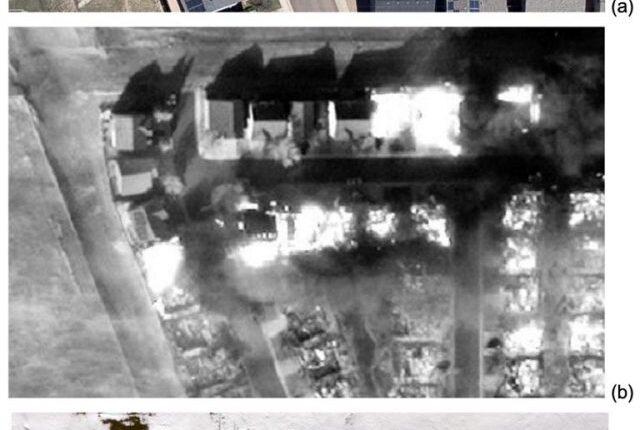
Figure 1. Satellite imagery depicting the Sagamore neighborhood, Colorado, (a) before, (b) during, and (c) after the Marshall Fire. Fires that burn a combination of structures and ecosystems have complex and varied impacts on drinking water sources and supply lines. Photos from Fischer et al., 2022.

Six months after the Camp Fire, a research team led by Purdue University scientists interviewed 233 households within the Camp Fire burn community regarding perceived post-fire water quality. The vast majority of participants (83 percent) reported uncertainty about water safety, and 85 percent sought alternate (non-municipal) water sources after the wildfire. Water advisories in the months following wildfires can be complex, complicated by sporadic data sampling, with water status oscillating between “safe to drink,” “boil water,” and “do not drink/do not boil.”

Communities impacted by the 2021 Marshall Fire also experienced impaired water quality in distribution lines during and after the fire, but constituents of concern were different than in the Camp Fire. The Marshall Firespread rapidly through communities, burning all thousand structures in a single day and creating gushing holes in the water distribution system. Along with widespread power outages, these holes left water managers hard pressed to keep distribution systems pressurized, jeopardizing access to municipal water to fight the fire. Given the urban setting, the decision was made to run untreated water through the municipal lines for a brief period, leading to municipal boil water advisories.

Climate models suggest that wildfires will gain in frequency, intensity, and size. As a result, water managers are settling into a future in which fire protocols and post-wildfire testing strategies will be the norm. The research conducted following the Marshall and Camp fires, in conjunction with the broader base of wildfire/water quality researchers and research, will help lay the groundwork for future resiliency efforts and community preparedness.

Research Cited
Maria Anna Coniglio, Cristian Fioriglio, and Pasqualina Laganà, “The Bottled Water,” in Non-Intentionally Added Substances in PET-Bottled Mineral Water (Springer, Cham, 2020): 11-28.
Philip E. Dennison et al., “Large Wildfire Trends in the Western United States, 1984-2011,” Geophysical Research Letters 41, no. 8 (2014): 2928-2933.
Erica Fischer et al., The 2021 Marshall Fire, Boulder County, Colorado (GREER Association, 2022).
Benjamin M. Gannon et al., “System Analysis of Wildfire‐Water Supply Risk in Colorado, USA with Monte Carlo Wildfire and Rainfall Simulation,” Risk Analysis 42, no. 2 (2022): 406-424.
Alexander Maranghides et al. “A Case Study of the Camp Fire–Fire Progression Timeline Appendix C. Community WUI Fire Hazard Evaluation Framework” (2021).
Winfred Mbinya Manetu and Amon Mwangi Karanja, “Waterborne Disease Risk Factors and Intervention Practices: A Review,” Open Access Library Journal 8, no.5 (2021): 1-11.
Deborah A. Martin, “At the Nexus of Fire, Water and Society,” Philosophical Transactions of the Royal Society B: Biological Sciences 371, no. 1696 (2016): 20150172.
Sheila F. Murphy and Jeffrey H. Writer, “Evaluating the Effects of Wildfire on Stream Processes in a Colorado Front Range Watershed, USA,” Applied Geochemistry 26 (2011): S363-S364.
Jonay Neris et al., “Designing Tools to Predict and Mitigate Impacts on Water Quality Following the Australian 2019/2020 Wildfires: Insights from Sydney’s Largest Water Supply Catchment,” Integrated Environmental Assessment and Management 17, no.6 (2021): 1151-1161.
Tolulope O. Odimayomi et al., “Water Safety Attitudes, Risk Perception, Experiences, and Education for Households Impacted by the 2018 Camp Fire, California,” Natural Hazards 108, no. 1 (2021): 947-975.
Caitlin R. Proctor et al. “Wildfire Caused Widespread Drinking Water Distribution Network Contamination,” AWWA Water Science 2, no.4 (2020): e1183.
Julien Ruffault et al., “Increased Likelihood of Heat-Induced Large Wildfires in the Mediterranean Basin,” Scientific Reports 10, no.1 (2020): 1-9.
Ge Shi et al., “Rapid Warming has Resulted in More Wildfires in Northeastern Australia,” Science of the Total Environment 771 (2021): 144888.
Habibullah Uzun et al., “Two Years of Post-Wildfire Impacts on Dissolved Organic Matter, Nitrogen, and Precursors of Disinfection By-products in California Stream Waters,” Water Research 181 (2020): 115891.
Daoping Wang et al., “Economic Footprint of California Wildfires in 2018,” Nature Sustainability 4, no.3 (2021): 252-260.

The post Water Quality Impacts Under The Worsening Wildfire Regime appeared first on Energy Innovation: Policy and Technology.

Wildfires are increasing in intensity, frequency, and size, decimating ecosystems and devastating communities. As worries about the impacts of wildfires grow, researchers are ramping up efforts to understand wildfires’ water quality repercussions. Studies conducted following the Marshall and Camp fires will help lay the groundwork for future water resiliency efforts and community preparedness.
The post Water Quality Impacts Under The Worsening Wildfire Regime appeared first on Energy Innovation: Policy and Technology.[#item_full_content]
By Olivia Ashmoore

Energy Innovation Policy and Technology LLC® has published updates to the Mexico and India Energy Policy Simulator (EPS) models and launched a new South Korea EPS model. The South Korea EPS was launched on the 3.3.1 platform in partnership with the NEXT Group. The Mexico model was upgraded to the newer 3.3.1 EPS platform to enable forecasting changes in jobs, gross domestic product (GDP), and public health impacts. Data for the India EPS model was updated to account for slower long-term GDP growth associated with the impacts from the COVID-19 pandemic.

South Korea EPS Model Launch

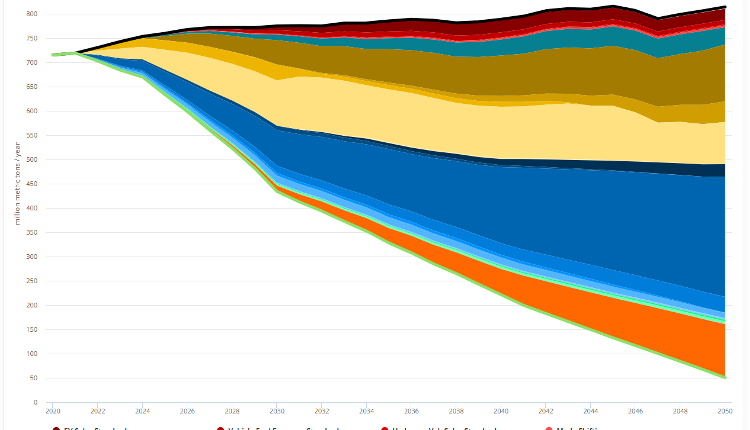
The South Korea-based NEXT Group and Energy Innovation® jointly developed South Korea’s first national-level EPS. South Korea is the world’s 12th-largest annual greenhouse gas (GHG) emitter, contributing approximately 715 million metric tons carbon dioxide equivalent (CO2e) in 2020.

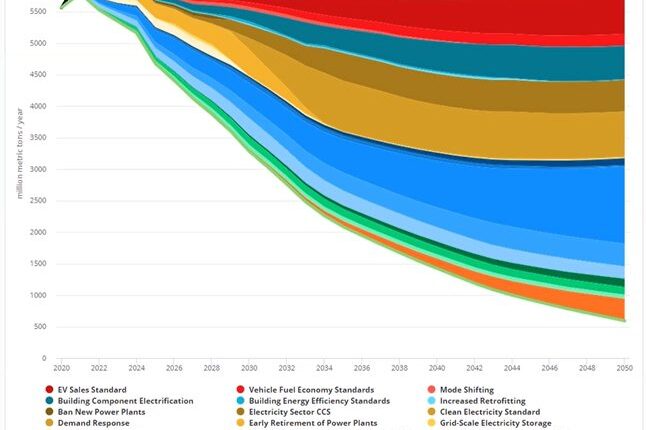
The South Korea EPS model features a Business-As-Usual (BAU) Scenario that shows a 14 percent increase in economy-wide emissions by 2050 absent any additional policy action. Alternatively, an Example Decarbonization Scenario shows additional climate policies can meet the South Korea’s ambitious Nationally Determined Contribution (NDC) goals of reducing emissions 40 percent below 2018 levels by 2030 and reaching net-zero emissions by 2050. The three most effective policies in the Example Decarbonization Scenario are industrial electrification and hydrogen fuel switching, converting hydrogen production to electrolysis, and no new coal or gas-fired powerplants.

South Korea’s Example Decarbonization Scenario emissions reductions by policy.

Mexico EPS Model Update

The Mexico EPS has been upgraded to the EPS 3.3.1 model platform, which includes new detailed economic outputs and data updates. The updated model can now track cash flows, capital investments, changes in GDP, and employment changes by economic sector. In addition, the 3.3.1 version includes new public health impacts and updated energy consumption data.

The Mexico EPS comes preloaded with a BAU Scenario and an Example Long Term Strategy (LTS) Scenario. The Example LTS Scenario would reduce emissions 50 percent below 2000 levels, create approximately 760,000 jobs in 2050, and would increase GDP about 1 percent in 2050. The most impactful policies are an electric vehicle sales standard, industrial electrification and hydrogen fuel switching, and a clean electricity standard. The Example LTS Scenario would also prevent 7,300 premature deaths and 218,000 asthma attacks in 2050.

Change in jobs by sector in Mexico’s Example LTS Scenario.

India EPS Data Update

The India EPS model was updated to account for slower near-term energy and economic growth resulting from the COVID-19 pandemic, and also includes an updated GDP forecast from the India Energy Security Scenarios. The India EPS includes a BAU Scenario and two policy scenarios—the Long-term Decarbonization Scenario and the Nationally Determined Contribution-Sustainable Development Goals Linkages Scenario—that show emissions reductions compared to the BAU forecast.

India’s BAU, Long-term Decarbonization, and NDC-SDG Linkages Scenarios.

All these features and updates are now available online. The EPS Video Series provides an introduction to the model’s capabilities, and users can explore the tool using the EPS web interface.

Subscribe to Modeling and Analysis email updates

* indicates required

The post Energy Innovation® Launches South Korea EPS model, Updates India And Mexico EPS models appeared first on Energy Innovation: Policy and Technology.

Energy Innovation Policy and Technology LLC® has launched a new South Korea EPS model in partnership with the NEXT Group and updated the Mexico and India Energy Policy Simulator (EPS) models. The Mexico EPS was upgraded to the 3.3.1 platform to enable forecasting changes in jobs, gross domestic product, and public health impacts, while India EPS data was updated to account for slower GDP growth resulting from the COVID-19 pandemic.
The post Energy Innovation® Launches South Korea EPS model, Updates India And Mexico EPS models appeared first on Energy Innovation: Policy and Technology.[#item_full_content]
Delicious 15-Minute Dinners

With so many offices returning to work, you and your family probably have to return to your previous schedules, which means you reach home tired and still need to make dinner, either for yourself or for your family. Instead of resorting to frozen dinners or take out every night, you can make a delicious and …

The post Delicious 15-Minute Dinners appeared first on U.S. Green Technology.

With so many offices returning to work, you and your family probably have to return to your previous schedules, which means you reach home tired and still need to make dinner, either for yourself or for your family. Instead of resorting to frozen dinners or take out every night, you can make a delicious and …
The post Delicious 15-Minute Dinners appeared first on U.S. Green Technology.

Researchers look to disrupt energy and health care industries with miniature pulsed power system

Pulsed power systems accumulate and store large amounts of energy for a certain period of time to be released instantaneously later.Pulsed power systems accumulate and store large amounts of energy for a certain period of time to be released instantaneously later.

You’ve heard of water droughts. Could ‘energy’ droughts be next?

Renewable energy prices have fallen by more than 70 percent in the last decade, driving more Americans to abandon fossil fuels for greener, less-polluting energy sources. But as wind and solar power continue to make inroads, grid operators may have to plan for large swings in availability.Renewable energy prices have fallen by more than 70 percent in the last decade, driving more Americans to abandon fossil fuels for greener, less-polluting energy sources. But as wind and solar power continue to make inroads, grid operators may have to plan for large swings in availability.

Starting an Eco-Friendly Blog in 2022

Saving the planet and doing whatever we can to change the paradigm in the world that pays no attention to climate change is something we all need to do. There are lots of ways to do so, and becoming sustainable is a matter of choice – and the best thing about it is that every …

The post Starting an Eco-Friendly Blog in 2022 appeared first on U.S. Green Technology.

Saving the planet and doing whatever we can to change the paradigm in the world that pays no attention to climate change is something we all need to do. There are lots of ways to do so, and becoming sustainable is a matter of choice – and the best thing about it is that every …
The post Starting an Eco-Friendly Blog in 2022 appeared first on U.S. Green Technology.

The Advantages of Using Geothermal Energy for Heating and Cooling

All of us know that geothermal energy is used for heating, but cooling? Yes, it is also used for cooling as well. Both heating and cooling are provided with the help of ground temperatures which remain constant.  It is such an eco-friendly source of providing energy with which you would end up saving almost 30% …

The post The Advantages of Using Geothermal Energy for Heating and Cooling appeared first on U.S. Green Technology.

All of us know that geothermal energy is used for heating, but cooling? Yes, it is also used for cooling as well. Both heating and cooling are provided with the help of ground temperatures which remain constant.  It is such an eco-friendly source of providing energy with which you would end up saving almost 30% …
The post The Advantages of Using Geothermal Energy for Heating and Cooling appeared first on U.S. Green Technology.

New transistor could cut 5% from world’s digital energy budget

A new spin on one of the 20th century’s smallest but grandest inventions, the transistor, could help feed the world’s ever-growing appetite for digital memory while slicing up to 5% of the energy from its power-hungry diet.A new spin on one of the 20th century’s smallest but grandest inventions, the transistor, could help feed the world’s ever-growing appetite for digital memory while slicing up to 5% of the energy from its power-hungry diet.

Converting solar energy to electricity on demand

The researchers behind an energy system that makes it possible to capture solar energy, store it for up to 18 years and release it when and where it is needed have now taken the system a step further. After previously demonstrating how the energy can be extracted as heat, they have now succeeded in getting the system to produce electricity, by connecting it to a thermoelectric generator. Eventually, the research—developed at Chalmers University of Technology, Sweden—could lead to self-charging electronics using stored solar energy on demand.The researchers behind an energy system that makes it possible to capture solar energy, store it for up to 18 years and release it when and where it is needed have now taken the system a step further. After previously demonstrating how the energy can be extracted as heat, they have now succeeded in getting the system to produce electricity, by connecting it to a thermoelectric generator. Eventually, the research—developed at Chalmers University of Technology, Sweden—could lead to self-charging electronics using stored solar energy on demand.

Organic semiconductor-based nanoparticles with long-lasting reactive charges

Due to their advantageous properties, organic semiconductors could be very promising photocatalysts for producing solar fuels. In fact, these materials can be synthetically tuned to absorb visible light, while simultaneously retaining energy levels that are desirable for driving various processes. While photocatalysts based on organic semiconductors have attained promising results, the understanding of the physics underpinning their functioning is still relatively limited.Due to their advantageous properties, organic semiconductors could be very promising photocatalysts for producing solar fuels. In fact, these materials can be synthetically tuned to absorb visible light, while simultaneously retaining energy levels that are desirable for driving various processes. While photocatalysts based on organic semiconductors have attained promising results, the understanding of the physics underpinning their functioning is still relatively limited.

Hirebucket

FREE
VIEW