By Olivia Ashmoore

Energy Innovation Policy and Technology LLC® has published updates to the Mexico and India Energy Policy Simulator (EPS) models and launched a new South Korea EPS model. The South Korea EPS was launched on the 3.3.1 platform in partnership with the NEXT Group. The Mexico model was upgraded to the newer 3.3.1 EPS platform to enable forecasting changes in jobs, gross domestic product (GDP), and public health impacts. Data for the India EPS model was updated to account for slower long-term GDP growth associated with the impacts from the COVID-19 pandemic.

South Korea EPS Model Launch

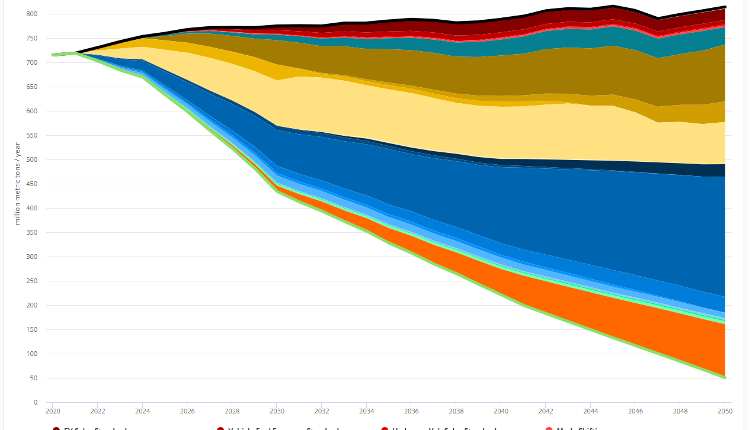
The South Korea-based NEXT Group and Energy Innovation® jointly developed South Korea’s first national-level EPS. South Korea is the world’s 12th-largest annual greenhouse gas (GHG) emitter, contributing approximately 715 million metric tons carbon dioxide equivalent (CO2e) in 2020.

The South Korea EPS model features a Business-As-Usual (BAU) Scenario that shows a 14 percent increase in economy-wide emissions by 2050 absent any additional policy action. Alternatively, an Example Decarbonization Scenario shows additional climate policies can meet the South Korea’s ambitious Nationally Determined Contribution (NDC) goals of reducing emissions 40 percent below 2018 levels by 2030 and reaching net-zero emissions by 2050. The three most effective policies in the Example Decarbonization Scenario are industrial electrification and hydrogen fuel switching, converting hydrogen production to electrolysis, and no new coal or gas-fired powerplants.

South Korea’s Example Decarbonization Scenario emissions reductions by policy.

Mexico EPS Model Update

The Mexico EPS has been upgraded to the EPS 3.3.1 model platform, which includes new detailed economic outputs and data updates. The updated model can now track cash flows, capital investments, changes in GDP, and employment changes by economic sector. In addition, the 3.3.1 version includes new public health impacts and updated energy consumption data.

The Mexico EPS comes preloaded with a BAU Scenario and an Example Long Term Strategy (LTS) Scenario. The Example LTS Scenario would reduce emissions 50 percent below 2000 levels, create approximately 760,000 jobs in 2050, and would increase GDP about 1 percent in 2050. The most impactful policies are an electric vehicle sales standard, industrial electrification and hydrogen fuel switching, and a clean electricity standard. The Example LTS Scenario would also prevent 7,300 premature deaths and 218,000 asthma attacks in 2050.

Change in jobs by sector in Mexico’s Example LTS Scenario.

India EPS Data Update

The India EPS model was updated to account for slower near-term energy and economic growth resulting from the COVID-19 pandemic, and also includes an updated GDP forecast from the India Energy Security Scenarios. The India EPS includes a BAU Scenario and two policy scenarios—the Long-term Decarbonization Scenario and the Nationally Determined Contribution-Sustainable Development Goals Linkages Scenario—that show emissions reductions compared to the BAU forecast.

India’s BAU, Long-term Decarbonization, and NDC-SDG Linkages Scenarios.

All these features and updates are now available online. The EPS Video Series provides an introduction to the model’s capabilities, and users can explore the tool using the EPS web interface.

Subscribe to Modeling and Analysis email updates

* indicates required

The post Energy Innovation® Launches South Korea EPS model, Updates India And Mexico EPS models appeared first on Energy Innovation: Policy and Technology.

Energy Innovation Policy and Technology LLC® has launched a new South Korea EPS model in partnership with the NEXT Group and updated the Mexico and India Energy Policy Simulator (EPS) models. The Mexico EPS was upgraded to the 3.3.1 platform to enable forecasting changes in jobs, gross domestic product, and public health impacts, while India EPS data was updated to account for slower GDP growth resulting from the COVID-19 pandemic.
The post Energy Innovation® Launches South Korea EPS model, Updates India And Mexico EPS models appeared first on Energy Innovation: Policy and Technology.[#item_full_content]

Artificial intelligence facilitates better control of global development aid

A team of AI experts led by Stefan Feuerriegel, Head of LMU’s Institute of Artificial Intelligence in Management, is injecting transparency into global development aid. The researchers have developed an artificial intelligence system that categorizes aid projects more comprehensively than it was possible up to now and facilitates better monitoring of these projects. The findings are published in the journal Nature Sustainability.A team of AI experts led by Stefan Feuerriegel, Head of LMU’s Institute of Artificial Intelligence in Management, is injecting transparency into global development aid. The researchers have developed an artificial intelligence system that categorizes aid projects more comprehensively than it was possible up to now and facilitates better monitoring of these projects. The findings are published in the journal Nature Sustainability.Computer Sciences

Robots are creating images and telling jokes: Five things to know about foundation models and the next generation of AI

If you’ve seen photos of a teapot shaped like an avocado or read a well-written article that veers off on slightly weird tangents, you may have been exposed to a new trend in artificial intelligence (AI).If you’ve seen photos of a teapot shaped like an avocado or read a well-written article that veers off on slightly weird tangents, you may have been exposed to a new trend in artificial intelligence (AI).Robotics

Data collected from acquaintances and even strangers can predict your locationon April 13, 2022 at 9:17 am

Data about our habits and movements are constantly collected via mobile phone apps, fitness trackers, credit card logs, websites visited, and other means.Data about our habits and movements are constantly collected via mobile phone apps, fitness trackers, credit card logs, websites visited, and other means.

New AI algorithms for cost-effective medical image diagnostics

Medical imaging is an important part of modern healthcare, enhancing both the precision, reliability and development of treatment for various diseases. Artificial intelligence has also been widely used to further enhance the process.Medical imaging is an important part of modern healthcare, enhancing both the precision, reliability and development of treatment for various diseases. Artificial intelligence has also been widely used to further enhance the process.Computer Sciences

Zoom launches AI-powered features aimed at sales teams

Today during its second Work Transformation Summit this week, Zoom announced Zoom IQ for Sales, a product that uses AI to analyze sales meetings and deals to provide insights. It’s the company’s first explicit foray into sales automation software, a market that — according to Verified Market Research — could grow to $7.3 billion in size by 2028.

Sales changed dramatically during the pandemic, when lockdowns forced companies — and their sales teams — to adopt digital tools to get work done. According to a 2020 McKinsey report, almost 90% of sales moved to a videoconference/phone/web sales model in 2020, as business-to-business companies in particular began to see digital interactions as highly important. An unaffiliated study from Harvard Business Review found 82% of companies believe that, out of all technologies, AI has the potential to “significantly” improve alignment between sales and marketing by introducing accountability.

“Zoom is always searching for ways to help our customers elevate their end customers’ experience and Zoom IQ for Sales is the latest development in that journey,” Josh Dulberger, Zoom’s head of product, data and AI, told TechCrunch via email. “Zoom IQ for Sales … [can] identify opportunities, assess risks, and ultimately enable and improve sales team performance. It uses natural language processing models to process post-meeting transcripts and deal progress data, generating insights for sales reps and managers.”

In many ways, Zoom IQ for Sales is an outgrowth of Zoom’s increasing investments in AI. Zoom last May introduced an AI-powered feature that shows highlights from recorded meetings, automatically selecting the “best” parts of meetings based on keywords from audio transcriptions. The company more recently acquired Kites, a startup specializing in real-time translation and transcription.

Image Credits: Zoom

Zoom IQ for Sales also marks the expansion of Zoom’s omnichannel contact center strategy, which arguably began with the launch of Zoom Contact Center in February. At the time, Zoom said it saw Zoom Contact Center as “supporting customer service use cases,” including upselling, by “combining unified communications and contact center capabilities [with Zoom].”

“Zoom has made strategic investments in homegrown speech recognition technologies and recruited a world-class team to produce high-fidelity transcription services that are a backbone for products like Zoom IQ …We’re developing domain-specific NLU (natural language understanding) using few-shot models to build features that will be more reliable and valuable to our users,” Dulberger continued. “Sales teams … want to focus on the customer, and managing the engagement rather than taking notes, but also so they can review their calls to pick up nuances, easily identify next steps, or solicit some guidance from a colleague. Managers and sales leaders can’t sit in on every call, but want to understand the selling climate, when to coach, and which reps are finding the right message.”

Zoom IQ for Sales generates an engagement score that aims to capture how attentive a given customer is based on “talk-time” ratio, the lag time between responses, and the number times that the customer speaks during the call. A separate metric, the sentiment score, measures “positive” and “negative” words and phrases used in meetings. Yet another score monitors the use of filler words like “oh,” “like,” “uh,” and “um,” which some studies show can have a negative impact on sales close rates.

Image Credits: Zoom

Beyond this, Zoom IQ for Sales attempts to identify “good” questions by treating the length of customers’ responses as a corollary for engagement. Sales teams can also feed a list of product features to Zoom IQ so that the software can count the number of times each feature is mentioned in the call.

“Zoom IQ for Sales’ analysis covers customers’ reactions, conversational and selling skills, customer pain points, competitors, deal risk metrics, and more,” Dulberger said. “[Sales teams can even] view [the] Salesforce deal status associated with recorded meetings.”

The jury’s out on the accuracy of Zoom’s algorithms, particularly given the company’s history of deploying flawed AI. Sentiment analysis algorithms are especially prone to gender and race bias, and not every salesperson will necessarily agree with how Zoom measures engagement.

Image Credits: Zoom

That aside, several platforms, including Gong and VoiceOps, already offer features similar to Zoom IQ for Sales — adding pressure on Zoom to demonstrate differentiation. Dulberger made a case for the strength of Zoom’s customer and product ecosystem, painting Zoom IQ for Sales as an opportunity for the company to bolster its broader platform.

Zoom is almost certainly feeling the pressure from investors to establish new lines of revenue. While the company’s earnings soared during the pandemic, guidance is down as customers begin to shift to hybrid and in-office work arrangements less reliant on videoconferencing.

“Half a million businesses choose Zoom and rely on it for internal and external conversations,” Dulberger continued. “The Zoom platform already has a strong foundation in this area with features such as transcription, recordings, and highlights. This also gives us an opportunity to expand this type of functionality across the Zoom platform such as Zoom Contact Center and within our meetings and events solutions to help presenters pace their speech, take notes, capture action items, or employ specific tactics.”

An external beta for Zoom IQ for Sales is currently ongoing. Alongside it, Whiteboard, Zoom’s virtual whiteboarding product, will be generally available beginning April 19. Two related features, Webinar Reactions (which lets webinar attendees use reactions) and Session Branding (which lets hosts customize webinar wallpapers), are available now, while the recently announced Zoom Events Backstage — a behind-the-scenes waiting space for webinar participants — is scheduled to launch in late April.

Today during its second Work Transformation Summit this week, Zoom announced Zoom IQ for Sales, a product that uses AI to analyze sales meetings and deals to provide insights. It’s the company’s first explicit foray into sales automation software, a market that — according to Verified Market Research — could grow to $7.3 billion in

Dear Sophie: I didn’t win the H-1B lottery. What are my next steps?

Here’s another edition of “Dear Sophie,” the advice column that answers immigration-related questions about working at technology companies.

“Your questions are vital to the spread of knowledge that allows people all over the world to rise above borders and pursue their dreams,” says Sophie Alcorn, a Silicon Valley immigration attorney. “Whether you’re in people ops, a founder or seeking a job in Silicon Valley, I would love to answer your questions in my next column.”

TechCrunch+ members receive access to weekly “Dear Sophie” columns; use promo code ALCORN to purchase a one- or two-year subscription for 50% off.

Dear Sophie,

I earned my master’s degree in business analytics last year, and have been working for a company while on OPT since then.

My employer entered me in the H-1B lottery last month, but I haven’t been selected. I heard that my degree now qualifies as a STEM field, making me eligible to continue working under OPT.

How can I stay in the States?

— Astute Analyst

Dear Astute,

Appreciate you reaching out; your questions are all too familiar this time of the year. The U.S. is losing out on the world’s best and brightest talent because of the way the H-1B lottery system is currently set up, but please rest assured — you’ve got options! I shared my insights into available options for people in your situation in my recent podcast, Not Selected in the H-1B, now what?

Most of your visa options will require your employer to sponsor you, so please include your employer and the company’s immigration attorney when brainstorming and planning your next steps.

The way ahead

Keep in mind that you still can be selected to apply for an H-1B. In 2020 and 2021, U.S. Citizenship and Immigration Services (USCIS) did not receive enough qualified applications to meet the annual quota of 85,000 after the March lottery, even though employers registered a record number of H-1B candidates.

So, the USCIS conducted subsequent draws to meet the annual quota — and that will likely happen again this year.

Still, I suggest carefully monitoring your OPT expiration date and pursuing backup options.

The two-year STEM OPT extension

Image Credits: Joanna Buniak / Sophie Alcorn

Yes, you are correct that business analytics is one of the 22 STEM fields of study added in January to the STEM OPT (Optional Practical Training) program, which extends Regular OPT for an additional 24 months. If you haven’t already, I suggest you meet as soon as possible with the designated school official (DSO) at your university to find out if you are eligible for reclassification to STEM.

BlueOcean raises $30M for its AI-based brand intelligence platform

The medium is the message more than ever these days, and brands are faced with a challenge — but also opportunity — to capture what consumers think about them and their products if they can harness and better understand those messages, via whichever medium is being used to deliver them. Today, a company called BlueOcean that has built an artificial intelligence-powered platform that it says can produce those insights is announcing $30 million in funding, money that it will be using to continue expanding its technology on the heels of rapid growth.

Insight Partners led the round, with FJ Labs also participating. Valuation is not being disclosed.

Digital life as it plays out these days has created a perfect storm (heh) for BlueOcean. We spend more time online than ever before, and the number of places where we might encounter a product or service has grown along with that: social media feeds are noisy with ads, content that feels like ads, lots of opinions; we do most of our news, information and entertainment sourcing online; we shop there, too; and many of us also spend our days working in cyberspace as well.

That’s a lot of real estate where a brand (or a brand’s competitors) might potentially appear, either intentionally or inadvertently, and more likely than not in a form that is outside of that brand’s control.

“Fragmentation is a huge driver,” Grant McDougall, the CEO who co-founded the company with president Liza Nebel, said in an interview. “There are silos all over the business and what we do sits over the top of that, to provide a common language to understand and talk to, for example, both to the CFO about revenue team as well as loyalty teams about messaging.”

At the same time, the tech industry that has built all of those online experiences has also built an enormous amount of tools to better parse what is going on in that universe. AI is playing a huge role in that navigation game: it’s too much for a single human, or even a large team of humans, to parse; and so a company like BlueOcean building tech to do some of that work for marketing professionals and others to have better data to work with becomes very valuable.

That has played out as a very significant evolution for the startup.

We last covered BlueOcean in 2020 when it was focused on a more narrow concept of digital brand identity: a company provided its website and a list of competitors, and one week later, for a price of $17,000, BlueOcean provided customers with brand audits that included lists of actionable items to improve or completely change. (As a point of contrast, typically brand audits for large brands can cost millions of dollars and typically do not come with specific pointers for improvement.)

Fast forward to today, and the company has expanded the scope of what it does for customers, and its overall engagement: its AI algorithms and big-data ingestion engine are now focused on providing continuous feedback to its customers, which subscribe to the service at fees starting at $100,000 per year. They use BlueOcean not just to measure their overall brand recognition in the market, but to track how specific products are performing; which launch strategies are working, and which are not; and the impact of different campaigns in different markets in real time so that they can change and respond more quickly.

“Lots has changed,” said McDougall. “We’re an AI powered brand intelligence platform. Access to insights and what competitors are doing are more relevant today than it’s ever been. What we do is collect information about brands out in public and help them understand performance relative to competitors, to help them take action to improve their brands to get market share.”

Interestingly, just as the Covid-19 pandemic has been a huge fillip to e-commerce and more generally online consumption of everything, so too has it played a strong role in the growth of BlueOcean and the approach that it takes. In the world of fast-paced and constantly changing and refreshed information, big-picture insights can be more meaningful than no picture at all, or one delayed for the sake of more detail.

“Covid has surfaced that speed is more important than accuracy,” noted Nebel. “We have data [to shape better] inclinations right now. It’s about making changes to capture opportunity.”

That concept has also clicked with its investors.

“Having invested in hundreds of the world’s most well-known brands, we know that having accurate and fast data is vital to brand health. We have extreme faith in BlueOcean and we’re excited to bring them into our investment portfolio,” said Fabrice Grinda, founding partner of FJ Labs, in a statement.

BlueOcean still also provides all-important competitive analysis but builds those lists of other companies and the data produced about them in conjunction with its customers, based in part on where the customer sees itself and would like to see itself; and also where it is as a brand in the real world.

It has also expanded its customer list: it now works with 84 brands, which may not sound like much except that these are some of the biggest companies in the world — they include Microsoft, Google, Amazon, Diageo, Cisco, Bloomingdales and Juniper Networks (and others that it cannot name) — and collectively represent what BlueOcean describes as $18 trillion in value and more than 6,000 brands — a list investors believe is poised to grow in line with how the internet itself is growing.

“After leading BlueOcean’s Series A round, we are proud to also lead their Series B to help them scale and serve even more brands,” said Whitney Bouck, MD at Insight Partners, in a statement. “As a former CMO myself, I know that marketing is constantly challenged to provide true ROI on brand marketing. BlueOcean gives marketing leaders quantifiable and actionable insights on brand performance for the first time, which we know is game-changing.”

8 cannabis investors share their outlook on the European market in H1 2022

Germany’s government created quite a buzz when it announced that recreational cannabis would be legalized during the current term. Does this mean that we’ll see recreational use of cannabis for adults becoming a common policy in Europe? It’s too soon to say.

After interviewing several active investors in cannabis-related startups, we learned that the regulatory and functional landscape in Europe is just as fragmented as it is in North America. Another important data point that connects both regions: the black market is a competitive factor. According to Europol, illicit spending on cannabis in the EU amounts to €9 billion each year.

However, things are moving on the legal side of the market — it appears medical cannabis still carries most of the momentum, and it is only accelerating. Around €354 million worth of unlicensed medical cannabis will be sold in Europe in 2022, according to market intelligence firm Prohibition Partners, and this number is expected to rise to around €2.3 billion by 2026.

Investments and M&A in the sector are also being spurred by Germany’s promised legislation.

“Our belief is that M&A will be front of mind for all legal cannabis operators. The difference in Europe is that there is opportunity for non-cannabis players to potentially get strategic and attempt to enter the market through an integration of cannabis as a CPG [consumer packaged good] or pharmaceutical-grade option,” said Todd Harrison, founding partner at CB1 Capital Management.

Also encouraging for producers and operators is the fact that medical cannabis isn’t verboten at a federal level across the EU, which lets companies legally sell their products across borders.

“This means that you can produce cannabis, for example, in Portugal, and sell to any EU country as long as you have export/import licenses. Hence, cross-border commerce in Europe is relatively fluid, meaning companies can scale relatively quickly if they know what they’re doing,” said David Bonnier, founding partner at Enexis AB.

We spoke with:

Todd Harrison, founding partner and CIO, CB1 Capital Management
Yoni Meyer, partner, Casa Verde Capital
Viken Douzdjian, managing partner and co-founder, Argonautic Ventures
David Bonnier, founding partner, Enexis AB
Will Gibbs, principal, Octopus Ventures
Oliver Lamb, co-founder and investment manager, Óskare Capital
Leah Fletcher, founder and director, Arbutus Innovation Centre
will.i.am, investor, Sanity Group

David Bonnier, founding partner, Enexis AB

What are some of the biggest challenges facing Europe’s cannabis industry right now?

Europe is largely a medical-only market right now. Unlike the U.S., medical cannabis in Europe is regulated as a medicine and falls under EU and national pharmaceutical regulatory systems.

As such, standards for production and distribution of medical cannabis are exceptionally high. Moreover, European doctors are generally more conservative and evidence-based. Therefore, it takes time to build the necessary infrastructure in order to get stakeholder buy-in.

Key challenges include (1) lack of education and buy-in from industry stakeholders such as physicians, research institutes, insurance companies, politicians, etc.; and (2) lack of downstream infrastructure such as research centers, specialized clinics, licensed wholesale distributors and manufacturers.

The good news is that since cannabis companies have to operate under pharmaceutical regulatory systems in Europe, we are seeing material accumulation of high-quality patient data.

While valuations are trending up, Germany’s exciting market developments still require business leaders to perform and scale. Viken Douzdjian, managing partner, Argonautic Ventures

Note that doctors in Europe can only prescribe a finished product to patients, unlike the U.S., where you only need a medical card. Patients must often follow up with doctors several times, which yields several valuable patient data points that can be used in real-world evidence studies.

As such, we believe Europe will most likely become a key leader on the research front for medical cannabis, which will further help lift the evidence base and general acceptance.

How are these issues informing your advice to your cannabis-related portfolio companies?

We are focused on companies that know how to navigate the European regulatory landscape and are filling key gaps in the market.

For example, we currently like the downstream part of the value chain, which has been underserved so far, including distribution companies, specialized clinics platforms, research and development centers, and companies that are accumulating patient data, which we believe will become very valuable over time. We also like ancillary businesses.

As in the U.S., legislation across Europe is fragmented but evolving. Are these situations comparable to you?

To an extent, albeit there are some key differences. Given that North America has already paved a pathway (starting in 1996 with medical cannabis in California, and again in 2012 with adult use in Colorado and Washington), legislation in Europe is accelerating at a faster pace.

While the Netherlands was first to legalize medical cannabis in Europe in 2003, the legalization wave really didn’t happen until much later, when Italy legalized, followed by Germany, Poland, the United Kingdom and many more. Currently, nearly 400 million Europeans now have legal access to medical cannabis in some form, which is more than in the U.S.

Also, Europe does not suffer from federal prohibition of medical cannabis like in the U.S. There is an EU-wide directive for production and distribution standards for medical cannabis products, which is interpreted by each country.

This means that you can produce cannabis, for example, in Portugal and sell to any EU country as long as you have export/import licenses. Hence, cross-border commerce in Europe is relatively fluid, meaning companies can scale relatively quickly if they know what they’re doing.

Which sector shows the most promise for growth in Europe this year: medical or recreational? Has the popularity of CBD products made investors more comfortable about recreational use?

While there is a lot of buzz around the use of cannabis by adults, it is still largely a non-existent market from a commercial standpoint. Malta has legalized (albeit it has a small population); the Netherlands is running a pilot program for legal production, which was previously illegal; Switzerland is running a commercial pilot program; and a few other countries have legalized home-grown cannabis for personal use.

Salsify secures $200M as the boom in e-commerce catapults its valuation to $2B

E-commerce is booming, but it’s become increasingly apparent over the years that the businesses that are able to capitalize on that trend — and contribute to that growth — are those able to grasp the right technology to navigate the space. Today, Salsify, one of the startups building e-commerce solutions to that end, is announcing a big round of $200 million, a sum that speaks both to the demand in the market, and its success to date.

“It’s been very busy,” CEO and co-founder Jason Purcell told TechCrunch in an interview. “The thing that catalyzed us in first place was the idea that multichannel commerce would become big, and in the last two years Covid has made that trend abundantly clear. We have doubled in size.”

Salsify’s platform is aimed at retailers, brands, and the various partners they work with to tap into centralised inventory and product information, data that can in turn be used to power more unified experiences wherever those products are sold. (Its favored term to describe this is the “digital shelf”, a reference point I think to the many companies it works with and their huge legacy businesses selling CPG goods on physical shelves.)

In 2021, ARR went up to $110 million and the company now has 1,200 customers, up from 800 when I last spoke with it in 2020. The list includes huge names like Coca-Cola, Libbey, KraftHeinz, Columbia and Mars.

This is a Series F and it values Salsify (named after the widely spreading wildflower) at $2 billion. That is a notable jump since the company didn’t disclose a number when it raised its Series E, a $155 million round in 2020 (PitchBook however puts it at $805 million, and before at $308 million in 2018). This latest round is being led by TPG, with Permira’s Growth Opportunities Fund, Neuberger Berman Funds, and Cap Table Coalition also participating. It has now raised more than $450 million.

In a venture market that is very active for e-commerce tech — just earlier today, another startup startup, UK’s Moot, that is building tech to help brands manage commerce across multiple platforms — announced $18 million in funding; last week another company in a similar space, Productsup, announced $70 million in funding — this round and valuation make Salsify one of the biggest contenders in this space.

And likely it is one attracting some attention from even bigger companies eyeing consolidation, although for now Salsify is focused on being the consolidator itself. Last year, US-based (HQ in Boston) Salsify acquired SKUvantage and Alkemics respectively to expand into Australia and France.

“Big brands want to operate at scale and this allows us to go into new geographies,” said Purcell. It also has operations in Portugal and the U.K. Some of the funding will be used, Purcell said, to continue breaking into more markets.

The challenge that Salsify is addressing is a pretty big one that has only gotten bigger with the growth of e-commerce. Starting from the basic building blocks of retail such as inventory management through to payments and logistics, there is still too much fragmentation and complexity in how e-commerce works. On the other side, the most savvy companies are using technology that gives them a leg up in managing all of this, Amazon being perhaps the most shining example of that. 

There have been dozens, probably hundreds, of tech companies built on the concept of arming the non-Amazons of this world with tools that help them compete with, and leverage, Amazon better. Salsify’s approach has been to tackle the problem as “experience management” (which it abbreviates to XM and attaches to each of its different product lines), and to look at it in the big picture, in terms of how it applies not just to brands but also retailers and the different companies that work in that complex supply chain, which all need information to do their jobs, but also potentially can provide critical insights (eg around inventory) to improve how the bigger process works.

That platform and wider integration functionality is also something that speaks to how bigger brands have seen that they need to work in modern times — gone are the days where their legacy supplier relationships and physical sales channels are enough in competition with newly emerging D2C competitors that leverage new platforms like social media apps and influencers to connect with new consumers.

It’s also why investors have come running to the company. Purcell described this latest round as “opportunistic,” in that the company still had capital from its last round in the bank but had been getting approached by investors looking to work with the company.

“As consumer behavior shifts increasingly towards digital and omnichannel, there has been an evolution in the way that brands think about their technology strategy and how they evolve their tech stack,” said Arun Agarwal, MD at TPG, in a statement. “Through its integrated platform, Salsify is optimizing the shopping experience for brands, retailers, and distributors, powering consumer interactions and enabling consistency, simplicity, and agility. TPG has a long track record of backing leading SaaS companies, and we look forward to partnering with Jason and his team to drive Salsify’s growth and market leadership further.”

✕
Hirebucket

FREE
VIEW